

Capital with Purpose
Doing the Difficult Things Malaysia Needs


Doing the Difficult Things Malaysia Needs

Malaysia’s first great economic ascent emerged from a profound reordering of the global economy.
Following the Plaza Accord of 1985, the sharp appreciation of the Japanese yen pushed manufacturing capital and industrial production across Asia in search of more competitive destinations. Malaysia was among the countries best positioned to benefit. We welcomed foreign direct investment, developed industrial zones, strengthened export capabilities, and embedded ourselves into global supply chains just as multinational firms were restructuring their operations across the region. The result was Malaysia’s “Tiger Cub Economy” era. Between 1988 and 1996, the country sustained average annual GDP growth exceeding 8%, driven by rapid industrialisation, surging exports and expanding employment.
However, China’s accession to the World Trade Organization in 2001 exposed the limits of this model. As global manufacturing capacity consolidated around China’s scale, infrastructure and supplier networks, Malaysia’s position as a host for production became harder to defend on cost alone. Hosting activity was no longer sufficient. Malaysia needed to retain more value by building local firms, technical know-how, intellectual property and ownership in the industries where we participate.
The very model that powered our rise also shaped our limitations. Malaysia became highly effective at attracting and hosting global production, but less successful at retaining the higher-value layers of innovation, intellectual property and technological ownership that ultimately determine long-term economic prosperity.
For a country to grow, it must attract activity. For a country to prosper, it must own more of the value created from that activity. While we have become adept at making things, the harder question today is how much value Malaysia actually retains. What are we giving away when we celebrate headline investment numbers? How much of the intellectual property, capital returns, strategic decision-making and future optionality remain here? And to what extent is this holding back our full potential?
The cost of prioritising headline investment volume over actual value retention is visible in our long-term developmental trajectory. Creating value and capturing value are not the same thing. While economic activity may take place within a country’s borders, measures such as Gross National Income (GNI) per capita ultimately reveal how much of that value remains and accrues to its people.
By absorbing foreign assembly functions more successfully than we scaled homegrown intellectual property, Malaysia became anchored in the middle-income trap. While Malaysia’s GNI per capita of USD11,650 as of 2024 remains below the World Bank’s high-income status threshold of USD13,935, South Korea has climbed to roughly three times Malaysia’s level at a GNI per capita of USD36,750. International benchmarks tell a similar story where South Korea represents ~26% of MSCI Asia ex Japan index weight, relative to ~1% for Malaysia.
The divergence reflects a deeper challenge in Malaysia’s productive capabilities. According to the Harvard Growth Lab’s Atlas of Economic Complexity, developed by Professor Ricardo Hausmann and Professor César A. Hidalgo, Malaysia ranks 32nd globally on the Economic Complexity Index (ECI), two places lower than a decade ago. Over the same period, countries such as Romania (23rd, ↑ 9 ranks), Lithuania (29th, ↑6 ranks) and Croatia (30th, ↑7 ranks) steadily improved their productive capabilities and overtook Malaysia in the rankings over the last decade, while Vietnam (45th, ↑17 ranks) continued to make notable gains. Although Malaysia maintains a relatively sophisticated export base, it has not expanded the diversity and complexity of its productive capabilities as rapidly as many of its peers. South Korea, by comparison, ranks 4th globally.
The premise is simple. A factory can export without creating ownership. A supply chain can employ Malaysian engineers while the intellectual property sits elsewhere. A multinational company can operate here while strategic decisions, capital returns and the highest-value functions remain at headquarters abroad.
In that model, Malaysia benefits, but only partially. We provide the labour, the infrastructure and the stability, but too much of the real value leaks out to other countries, companies and stock exchanges.
This bears resemblance to the “hotel economy” concept, where a hotel can be bustling and important to the activity within it, yet the most valuable conversations and decisions in the lobby lounge do not belong to the hotel. A billion-ringgit deal can be struck there, but the hotel captures only the relatively nominal value of providing the venue and services.
The solution is not to close the hotel. Foreign investment and global supply chains remain essential. But Malaysia must participate more meaningfully in the value being created, not merely provide the location where it happens. We must use the presence of global capital and multinational companies to build deeper Malaysian capability, stronger local firms, greater technical know-how and more domestic capital ownership in the sectors that will define the future.
Building the Letters of a More Complex Economy
This work is inherently difficult. Building the kind of economy that owns, rather than merely hosts, is not a simple undertaking. Development economist Professor Ricardo Hausmann defines economic complexity as the know-how embedded in firms, industries and people that allows a country to produce sophisticated goods and services.
Think of economic development like a game of Scrabble. Every player starts with the same board, but the points you score depend on the letters you hold. Vowels are essential because without them, no word gets formed. However, they carry the lowest point value in the game. It is the consonants, the rarer and harder-to-acquire letters, that determine whether you score modestly or dominate the board. The consonants allow a player to form complex, high-value words & sentences to dominate the board.
For economies, the same principle holds. High-income jobs are created when a country is able to combine higher value alphabets to elevate its economic complexity by producing what few others can. We become price takers if we sell commoditised and undifferentiated products such as palm oil or semiconductor assembly and testing services. We become price setters if we build capabilities that are difficult to replicate, such as advanced chip design and specialised pharmaceutical development.
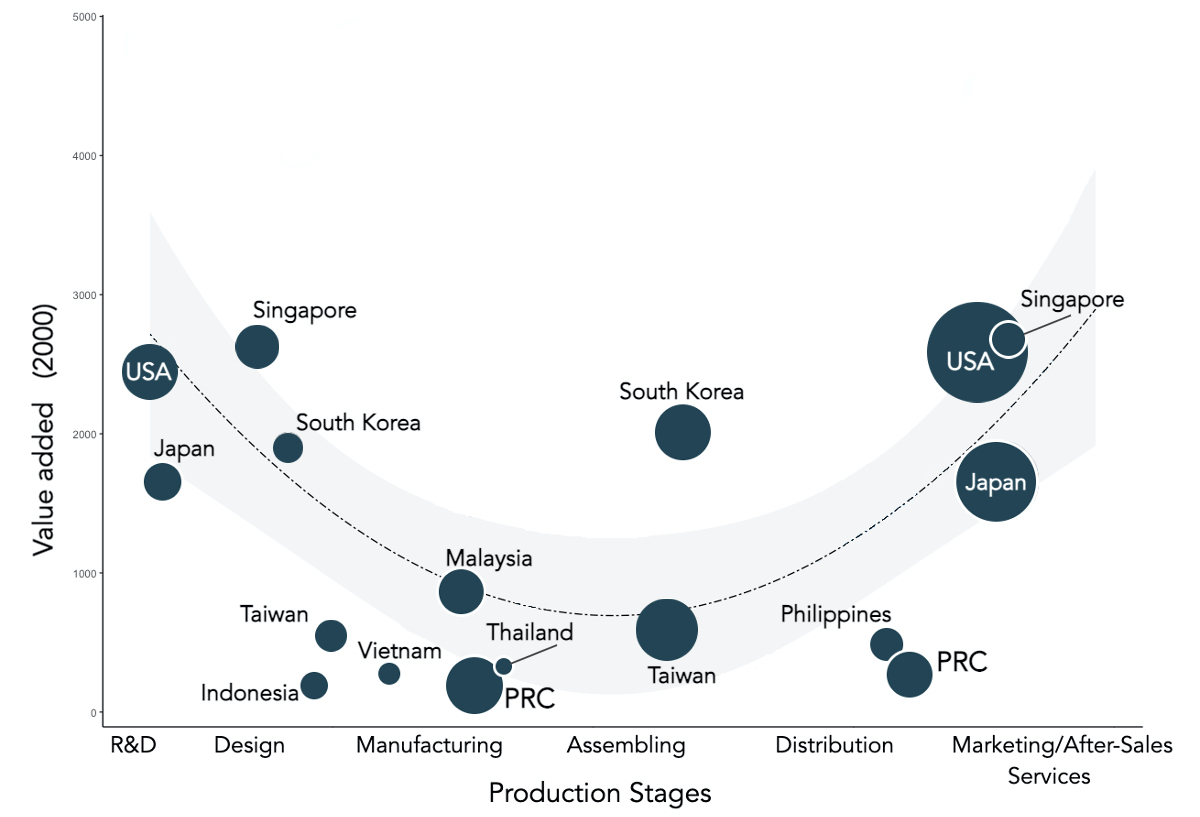
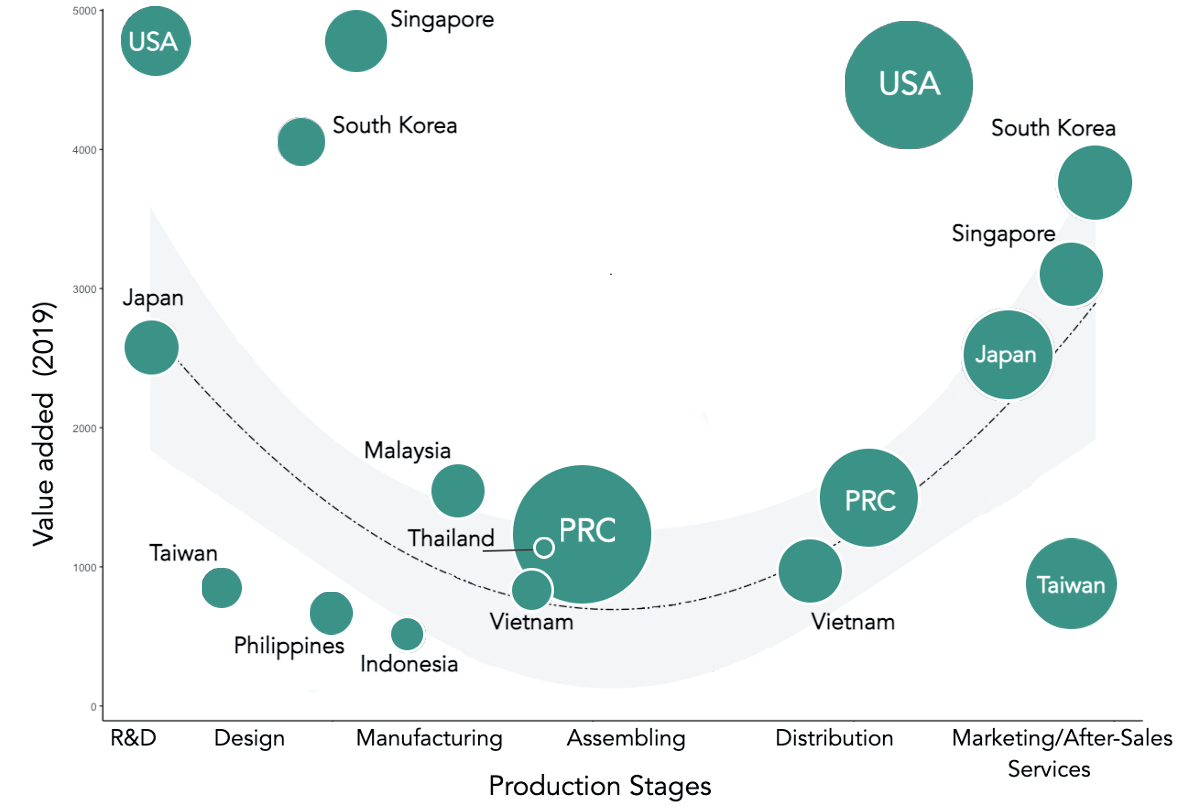
Malaysia’s development story can be read through this lens. We, like many other countries, already possess many of the “vowels” of development: roads, ports, industrial zones, connectivity, and basic manufacturing capacity built over decades of investment. These are essential foundations. But in the language of global value chains, they often anchor us near the base of the economic Smile Curve: the high-volume, lower-margin territory of physical processing and contract assembly, that positions us as price takers and ultimately limits how far household incomes and wages can rise.
Positions along the Smile Curve (2000 vs. 2019)
Source: MarcoPolo.org analysis
Malaysia has long occupied this base of the Smile Curve. For decades, that position served us well. We attracted FDI, built industries and achieved growth by offering what multinational supply chains needed: reliable production at competitive cost.
That proposition is now under structural pressure. Across the region, lower-cost economies, including Vietnam and Thailand, have emerged as credible alternatives, eroding the labour-cost differential that once underpinned our model. Competing with Vietnam & Thailand on cost alone is a race to the bottom, a race that Malaysia will lose. Malaysia is caught between two positions: no longer cheap enough to compete comfortably at the base, but not yet sufficiently equipped to command the high-value ends of the curve. Essentially, Malaysia remains “stuck in the middle” as per Professor Richard Vietor from Harvard Business School.
The base of the curve is no longer a place Malaysia can afford to stay. We must climb. We now require the “consonants”: know-how, technology, domestic capability and firms capable of competing beyond our borders. Some of these consonants already exist within Malaysia, but they reside largely within multinational firms. The know-how is here, the technology is here, but the ownership and diffusion into local hands remains shallow. These consonants represent the ascending, high-value sections of the curve: upstream research and proprietary intellectual property on one end, and downstream branding, distribution and market access on the other.
If we fail to build these consonants, we remain confined to the bottom of the Smile Curve, providing the location where value is created while the true wealth of industry continues to be captured elsewhere. Again, creating value does not necessarily mean capturing it. A country may manufacture the product, employ the workforce and facilitate the transaction, yet the largest share of economic value often accrues to those who own the intellectual property, control the technology, shape the brand and direct the flow of capital.
This is Khazanah’s role as a purpose-driven investor. We are not merely an investor in the narrow sense of purchasing assets for returns. We are an institution designed to act where national value can be built, particularly where the market moves too slowly, too cautiously or too narrowly.
Our historical blueprint reflects this mandate. Khazanah helped consolidate a fragmented domestic healthcare landscape and supported the creation of what became a global champion in IHH Healthcare. We also anchored large-scale regional economic development through investments such as Iskandar Malaysia in Johor, at a time when private capital deemed the developmental risk too high.
This requires more discipline, not less.
We must operate in spaces where markets are still forming, risks are difficult to price and ecosystems are fragmented. Returns may be non-linear. They may not always flow directly back to the initial investor. They may appear instead as supplier depth, tax revenue, technical knowledge, better jobs, stronger firms and deeper local ownership.
This is what I sometimes call “foundational investing”: investing when the ecosystem is still young, before the market has fully formed, and before success is obvious. It is not undisciplined investing. In fact, it requires greater discipline because the path is uncertain and the impact may compound across the ecosystem rather than appear immediately on a single balance sheet.
Not every effort will reach maturity. But that is not failure. It is the price of building something authentic.
South Korea’s experience reminds us that countries which climb the development ladder often make deliberate choices before the payoff is visible. They build institutions, back capability formation and take risks long before the market sends obvious signals. In doing so, they would have to accept periods of uncertainty, missteps and short-term sacrifice in exchange for greater long-term economic resilience and competitiveness. They understand that value appears not only as financial return, but also through industrial depth, technical capacity, local ownership and globally competitive firms.
Dana Impak: Catalytic Capital for the Difficult
Dana Impak is Khazanah’s catalytic capital platform to support Malaysia’s next stage of economic development. Under the Ministry of Finance’s GEAR-uP initiative, Khazanah has committed RM6 billion to help advance Malaysia’s economic complexity by strengthening firms, building capabilities and catalysing strategic ecosystems.
This is not capital deployed for sustainable financial returns alone. It is catalytic capital deployed with strategic intent, targeted at areas where market gaps remain and where funding, enterprise support, technical capability and ecosystem coordination need to come together.
Through Dana Impak, Khazanah is helping Malaysia build the consonants of a more complex economy: stronger firms, deeper capabilities and new engines of growth that are harder to build, but necessary for the country’s next stage of development.
Jelawang Capital: Catalysing the Malaysian venture capital and startup ecosystem
At the early stage of the company lifecycle, Malaysian startups require more than funding. They need institutional capital, capable fund managers, market access and regional networks to scale.
Building a company is like raising a child: different stages of growth demand different kinds of parents. There is the Foundational Parent, who sets purpose and direction in the early years. The Skilled Parent, who instils discipline and builds capability as the child develops. The Innovation Parent, who brings exposure to new ideas and unlocks the next level of potential. And the Accountability Parent, who imposes the rigour that turns a good child into a great one.
Capital works the same way. The Foundational Parent is patient, long-term institutional capital willing to back potential before it is proven. The Skilled Parent is represented by private equity and operational partners who bring transformation playbooks and scale. The Innovation Parent is venture capital and technology networks that open access to frontier capabilities. The Accountability Parent is public markets, where performance is tested and rewarded. No single parent raises the child alone, and no single capital type builds a company to its full potential. Through Jelawang Capital, Khazanah supports Malaysia’s venture capital ecosystem via the Emerging Fund Managers Programme and the Regional Fund Managers Initiative. To date, around RM300 million of investments have been mobilised, with more than RM30 million crowded in from external co-investors for Emerging Fund Managers Programme managers.
The companies emerging from this pipeline show how early-stage capital can support both commercial scale and domestic capability.
Aonic is a Malaysian drone solutions company operating in 15 countries, serving plantation groups and improving rural productivity at scale. DF Automation was founded by Universiti Teknologi Malaysia alumni who turned university research into autonomous mobile robots deployed by manufacturers worldwide. ServAuto rebuilt Malaysia’s fragmented automotive aftersales market with a digital platform that served over 30,000 customers in its first year. These are not yet national champions in the old sense. But they represent something Malaysia needs more of firms that combine local problem-solving with technology, regional ambition and exportable capability.
Together, these companies reflect the role of catalytic capital in helping Malaysian firms turn early promise into commercial scale, adding new letters to Malaysia’s economic vocabulary and expanding what the country is able to build.
Mid-Tier Companies: Strengthening the Missing Middle
Further along the growth trajectory, Dana Impak focuses on Malaysia’s “Missing Middle”.
Mid-tier companies are an important part of the economy, contributing around 36% of national Gross Domestic Product and 16% of national employment. Yet many continue to face constraints in accessing the right form of growth capital, strengthening operational capabilities and preparing for larger-scale expansion.
Khazanah addresses this through a dual-track approach, combining capacity development with growth capital through private equity and private credit strategies.
The capital track supports value creation and provides alternative financing solutions, including non-dilutive capital. Capacity development efforts such as the Mid-Tier Company Growth Innovation Programme and ELEVATE, in partnership with the Securities Commission Malaysia, help mid-tier companies sharpen their growth strategy, improve investor readiness and boost productivity to unlock innovation-led growth.
To date, more than 50 Malaysian mid-tier companies have been supported. NSW Automation, a precision fluid dispensing systems company serving the semiconductor industry, is commercialising high-precision technology for next-generation advanced packaging customers globally. Jalen, a Malaysian consumer brand known for its household kicap products, is applying the Working Backwards methodology through the Mid-Tier Company Growth Innovation Programme to identify new growth opportunities that better serve evolving consumer needs, with its concept currently under testing and validation. The missing middle matters because Malaysia cannot rely only on large incumbents or early-stage startups. We need more firms in the middle that are capable of scaling, professionalising, innovating and eventually competing beyond Malaysia.
Semiconductors and Advanced Manufacturing: Moving Up the Value Chain
A core part of raising Malaysia’s economic complexity lies in moving beyond lower-value activities into higher-value capabilities such as integrated circuit design, advanced packaging, equipment and materials.
Dana Impak supports this shift through targeted investments across the semiconductor and advanced manufacturing ecosystem. This includes anchor investments into specialised vehicles such as the ViTrox-backed Cambrian Fund, as well as direct and indirect exposure to companies building capabilities in integrated circuit design, advanced packaging and frontier technologies.
SkyeChip shows how this targeted ecosystem approach can support companies across the lifecycle. From early venture support through Gobi Partners Dana Impak Ventures to Khazanah’s participation as a leading cornerstone investor alongside EPF, LTAT, Tabung Haji and other institutional capital providers, SkyeChip reflects the relay race of capital needed to support potential Malaysian champions.
Its Main Market debut on Bursa Malaysia marks an important milestone for Malaysia’s semiconductor ambitions and the development of higher-value integrated circuit design capabilities. With more than 300 specialised integrated circuit design engineers and over 100 patents in artificial intelligence and high-performance computing, SkyeChip reflects Malaysia’s growing depth in semiconductor intellectual property.
Dana Impak also supports companies that can anchor new technical depth in Malaysia.
NanoSkunkWorkX, founded by Malaysian entrepreneurs including a NASA-trained scientist, is developing graphene-based platforms with potential applications across semiconductors, hydrogen and diagnostics. Cortical Labs, co-founded by a Malaysian entrepreneur, is building a Malaysian engineering presence around systems that combine living neurons with silicon. Syntiant’s expansion into Penang brings manufacturing and research and development capabilities into Malaysia, creating around 800 high-tech jobs and strengthening the country’s role in edge artificial intelligence and advanced semiconductor applications.
The point is not that every company will become a giant. The point is that Malaysia must accumulate more technical nodes in the ecosystem: engineers, patents, supplier relationships, manufacturing know-how, research capability, capital-market pathways and companies with the ambition to compete globally.
The Commitment to Patient Capital
This model reflects a simple reality: meaningful capability-building takes time.
Some investments require longer horizons, and the returns may not always appear first on a single corporate balance sheet. They may show up instead as deeper supplier networks, stronger technical capabilities, higher-value jobs, tax revenue and more competitive Malaysian firms.
The greater risk is not in entering these complex spaces. The greater risk is avoiding them, leaving Malaysia with only the letters of its past while the next generation of global industries is written elsewhere.
Owning More of Malaysia's Future
For many Malaysians, this challenge is not abstract. It is reflected in wages, job quality, skills, business ownership and whether the next generation can access industries with a future. GDP growth alone is not enough if it does not create better pathways for Malaysia and Malaysians to advance.
We often speak about development in large numbers: billions of ringgit of investment, percentage points of GDP growth, export values, market share and productivity statistics. These numbers matter. They help us measure progress. But the real test is whether these numbers translate into stronger Malaysian firms, deeper local capabilities, higher-value jobs and greater ownership of the value created in our own economy.
Behind every number is a life. Behind every industry is a worker trying to upgrade his skills, a young graduate deciding whether to remain in Malaysia, an entrepreneur trying to build something difficult, and a family hoping that the next generation will live with greater opportunity than the last.
This is the deeper purpose of Dana Impak. It is not only to deploy capital, but to help Malaysia create the conditions where more of these individual stories can become stories of progress. It is capital deployed to help Malaysia build the firms, skills, technologies, intellectual property and ecosystems that allow us to participate more meaningfully in the industries that will define the future.
This requires patience and discipline. Some returns will appear directly as financial gains. Others will appear as supplier depth, technical capability, tax revenue, better jobs, stronger firms and more competitive Malaysian companies. Not all of these returns will be captured immediately on a single balance sheet, but they matter because they strengthen the productive base of the country.
No single institution can do this alone. Dana Impak can catalyse, but the work of building a more complex economy requires government, regulators, universities, institutional capital, private capital, entrepreneurs and firms to move with shared purpose. The middle-income trap was not created by one decision, and it will not be dismantled by one institution.
The difficult things are difficult precisely because they require sustained effort before the payoff is obvious. But if Malaysia wants to move beyond hosting activity to owning more of the value created from that activity, these are the things we must do — patiently, collectively and with discipline.
“At Dana Impak, impact is not a slogan. It is an investment discipline. We deploy catalytic capital where it can strengthen Malaysian firms, support potential champions and build ecosystems that are critical to Malaysia’s next stage of growth.”
Kayse Foo
Interim Head of Dana Impak
Spotlight: Dana Impak Beneficiaries

Company name
Polisea Sdn. Bhd. (“PolicyStreet”)
Purpose / Mission
Homegrown insurtech company providing digital insurance distribution, embedded insurance, employee benefits and advisory services for individuals, gig workers, SMEs and businesses
Dana Impak programme
Direct investment from Khazanah in June 2023, leading Policy Street’s Series B round under Dana Impak
Milestones

Serves over
10 million customers/policyholders

Works with more than 40 insurance and takaful providers

Extended protection to gig economy workers, MSMEs and businesses

Achieved profitability in FY2025

Secured RM84 million (USD21 million) in the first close of its Series C funding round in April 2026, led by Cool Japan Fund, Japan’s sovereign wealth fund
Why It Matters
PolicyStreet reflects how the relay race of capital can help Malaysian startups progress from early ecosystem support to wider institutional backing. From pitchIN and MyCIF support, to Khazanah’s Dana Impak-led Series B investment, and now its latest Series C round led by Cool Japan Fund, its journey shows how catalytic capital can help crowd in wider participation around promising homegrown companies. Beyond startup growth, PolicyStreet is helping increase insurance penetration in Malaysia, narrow protection gaps and improve the country’s overall insurance coverage, while building a technology-enabled financial services platform with regional potential.
Sources:

Company name
JAZRO Technology Berhad (“JAZRO”)
Purpose / Mission
Homegrown robotics edtech company focused on nurturing young Malaysian digital talent through robotics, coding and STEM education for students aged 7–17
Dana Impak programme
VC & Startup Programme
Received early-stage funding from Dana Impak in 2024 (via Gobi Dana Impak Ventures) through the Future Malaysia programme
Milestones

Founded in 2020

Reached more than 126,000 students

Operates 5 centres across 3 states, namely Terengganu, Selangor and Penang

Achieved 86% student retention rate

Developed a structured in-house curriculum with 5 levels, 50 classes and around 100 learning hours
Why It Matters
JAZRO shows how talent development can begin far upstream. What started as a father’s effort in Kerteh, Terengganu to find a robotics programme for his son has grown into a homegrown robotics edtech platform reaching more than 126,000 students across Malaysia. With nearly 40% of workers’ core skills expected to change by 2030, JAZRO’s work in expanding access to robotics, coding and AI education helps prepare young Malaysians for a technology-driven future. Its journey also reflects the relay race of ecosystem support, from PETRONAS Innovation Garage to investment backing through Gobi Dana Impak Ventures, helping a small East Coast classroom scale into a platform nurturing Malaysia’s next generation of digital talent.
Sources:

Company name
Jalen Sdn Bhd (“Jalen”)
Purpose / Mission
Halal food manufacturing company known for its flagship soy and chilli sauces, serving mass-market Malaysian households and export markets
Dana Impak programme
Mid-Tier Growth Innovation Programme (MGIP)
Milestones

Founded in 1981 (as Jalil Enterprise) with a focus on manual production and soy sauce specialisation

Incorporated as Jalen Sdn Bhd and moved to a 3-acre industrial facility in 1990

Supported by a workforce of 400 Malaysian employees across manufacturing and distribution


Why It Matters
From its beginnings as Jalil Enterprise in 1981 to becoming a familiar household kicap brand today, Jalen reflects the strength of Malaysian family businesses built on resilience, values and long-term ambition. Through MGIP, Jalen is applying the Working Backwards methodology to better understand evolving consumer needs and test new concepts beyond its traditional core. Its journey shows how structured enterprise support can help Malaysian MTCs preserve heritage while building for the future, turning manufacturing depth and brand familiarity into more consumer-led, innovation-driven growth.
Sources:

Company name
SkyeChip Berhad (“SkyeChip”)
Purpose / Mission
Leading Malaysian semiconductor intellectual property (“IP”) and integrated circuit (“IC”) design company developing silicon IP and custom application-specific IC for artificial intelligence and highperformance computing applications.
Dana Impak programme
- Direct investment, with Dana Impak participating as a leading cornerstone investor in SkyeChip’s Main Market listing in May 2026
- Early support through Dana Impak and Jelawang Capital-backed venture capital partners since 2024, including Gobi Partners via Dana Impak
Milestones

Commenced operations in 2020 and is headquartered in Penang, specialising in silicon intellectual property and custom ASIC solutions for AI and high-performance computing applications

Led by senior Malaysian IC design talent with deep experience from Intel, Altera and Broadcom-linked companies, anchoring local front-end semiconductor capability


Raised up to RM352 million through its Main Market IPO, with more than 60% of proceeds allocated for research and development

Listed on the Main Market of Bursa Malaysia in May 2026, with Khazanah participating as a leading cornerstone investor alongside EPF, LTAT, Tabung Haji and other institutional capital providers

Public tranche was oversubscribed by
95.03 times, generating RM3.04 billion in demand, the largest since PETRONAS Chemicals Group Berhad’s IPO in 2010 and ahead of Felda Global Ventures in 2012
Why It Matters
SkyeChip is a proof point for Malaysia’s shift from semiconductor participation to semiconductor ownership. Its journey reflects the relay race of capital needed to build potential Malaysian champions, from early support through Dana Impak and Jelawang Capital-backed venture capital partners to Khazanah’s direct participation as the leading cornerstone investor during its Main Market listing. By building capabilities in IC design, semiconductor intellectual property and AI-related chip solutions, SkyeChip reflects Malaysia’s growing depth in higher-value semiconductor activities, while helping seed the talent and capability flywheel needed to move Malaysia up the value chain.